|
|
Baldassare Forestiere’s “Underground Gardens”
Baldassare Forestiere was born July 8, 1879 in Filari, a small village in the Peloritani Mountains in the Province of Messina. Baldassare’s tyrannical father, Rosario, owned an olive factory and adjacent groves, which provided a reliable income for the Forestiere family. However, he was unwilling to share his economic resources with his four sons, Antonio, Baldassare, Giuseppe, and Vincenzo.4 Unable to foresee any opportunity for himself within his father’s business or elsewhere in Sicily, in 1902, at the age of twenty-one Baldassare emigrated, along with his older brother, Antonio, to America.5
-----------------------------
After working on the east coast and the central California coast, Forestiere finally settled in Fresno in 1906. Settling in the far north end of Fresno, he was far removed from the Italian community located approximately ten miles southwest of him in the immigrant neighborhood known as the West Side. Forestiere lived a relatively isolated life in his new home.6 From this remote plot of land he would begin his own version of the immigrant success story. He first worked for others. In typical immigrant fashion, he lived frugally, saved his money, and gradually began purchasing vineyards. By the time of his death, he would own more than 1000 acres of valley farmland.
--------------------------
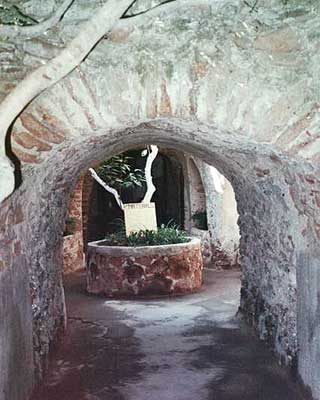
Though the dry, semi-arid climate of the valley contrasted with the mild climate of his native Filari, Fresno had one major resource that Sicily historically did not provide for its peasants: an abundance of cheap land. Soon after purchasing the parcel, Forestiere built a small, wooden house on the barren land in advance of planting an orchard. He would soon find that the valley heat during the summer in his new home (which he often referred to as his “little sweat house”) made living intolerable. To support himself upon his arrival in Fresno, he worked as a leveler and a grafter for other valley farmers.7 However, when Forestiere began planting his own orchard, he soon discovered that approximately twenty-four inches below the topsoil was a thick layer of impermeable hardpan, a concrete-like packed clay that underlies many sections of the valley floor. His land was not suitable for trees. Perhaps the low cost of the acreage should have raised the suspicions of this poor, Sicilian immigrant. Forestiere never planted his orchard. Instead, after work each day, he returned to his small wooden house and began digging his caverns under his isolated ten-acre plot of land near the corner of Shaw and Cornelia Avenues. Forestiere would spend the next forty years, until his death in 1946, living in and digging what would become known as the Underground Gardens.
The stories that circulated within Fresno’s Italian community depicted Forestiere as an eccentric. During his lifetime, he became an embarrassment to some, but not all, members of his family. A few of his relatives even urged him to stop digging his grottoes.8 As word spread of his work on his caverns, local residents in the Italian community were quick to label him the “human mole,” a term that has unfortunately come to characterize his life to a wider public.9 But the reality is that Forestiere’s life was in many respects similar to that of most Italian immigrants, both in what he accomplished in his over forty years as a successful farmer in the San Joaquin Valley and what his remarkable Underground Gardens expresses to us today.
-------------------------
By day, Forestiere worked in his remote vineyards. Each night after work, he descended and dug with his pick and shovel. Their muted scraping against the valley’s loamy subsoil below the thick layer of hardpan was the only sound that accompanied him in his isolated life underground. He explained to his relatives that his project was his relaxation after a hard day in his vineyards.10 In his imagination he took the religious and secular forms — arches and grottoes — of his remembered Sicily and recreated them in his tunnels. Forestiere’s grottoes became for him the private world of his past, which he would inhabit nearly exclusively until his death in 1946.
While Forestiere’s life underground may appear eccentric to his observers, his grottoes have cultural and historical antecedents in Sicily. In the first place, in ancient Greek myth, many of its gods and demigods lived underground and in grottoes, some even under the sea. The fabled giant shepherds, the Cyclopes, from Homer’s Odyssey, lived in the bowels of Mt. Etna, where they forged Zeus’ thunderbolts.11 In Sicily these legends formed part of the general cultural milieu of peasants, as well as land-owning latifundi, who learned these tales in school. The region that surrounds Forestiere’s native village also contains many underground dwellings and structures. The hillsides near the village of Rometta Marea, for example, contain a vast number of Saracen caves in which he and his brothers played as children.12 Dating from the ninth century, when the Arabs invaded and colonized Sicily, these caves, dug out of the limestone cliffs, served originally as storage depots for food and armaments, as well as housing for Saracen soldiers. As late as the nineteenth century, these caves provided storage for grain and shelter for shepherds tending their flocks on the remote hillsides.13 South of Messina, Syracuse contains a plethora of catacombs, grottoes, sepulchers, and mines. Over the centuries these underground structures have been used as prisons, garrisons, work places, and domestic dwellings.
Certain aspects of the Underground Gardens bear a resemblance to the catacombs of San Giovanni in Syracuse. The catacombs’ “conic-tapered venture” constructed for light and to enhance airflow are remarkably similar to the skylight openings that Forestiere designed in his chambers.14 Just as important, the asymmetrical pattern of Forestiere’s tunnels and grottoes reflects as well the sometimes “confusing geometry” of the San Giovanni catacombs.15 Further, in the late nineteenth century, when Sicily’s sulfur mining industry employed nearly two hundred and fifty thousand people, many miners, including entire families, lived in “underground grotto[e]s.”16 In his youth, Forestiere was adventuresome. Sleeping whenever he could, he would disappear for days in his explorations of the surrounding hillsides and neighboring towns and villages.17
| Home | | | Prev | | | Next | | | End |