|
|
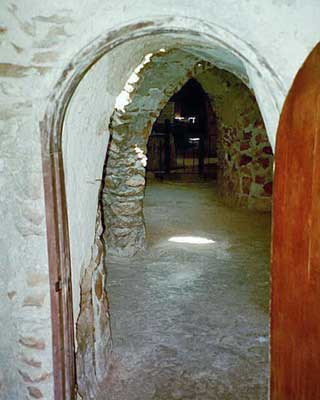
Forestiere’s grottoes have both practical and aesthetic dimensions. He devoted the first ten years to excavating his living quarters. To escape the searing summer heat, he fashioned a kitchen with a properly vented wood-burning stove, a chamber with two beds, and finally a living room.18 Adjacent to his living quarters, he constructed what he called the “Sunrise Plaza,” designed to capture the morning sun. The “Sunrise Plaza” also contains a small fishpond in which Forestiere placed fish, which he caught in nearby rivers and lakes, until he was ready to eat them.19 One bed was adjacent to a window that overlooks the “Sunrise Plaza” and was designed to let in the light and warmth of the spring and summer months. During the long valley winter months when bright sunlight was less frequent and valley temperatures plummeted, he slept in his winter bed, which was located deep inside the bedchamber and closer to the stove. He also dug a room for the storage and production of wine and cheese and the curing of meat, important aspects of the Sicilian culture he had left behind in Filari. In the evenings throughout the year, when he was not digging in the dark recesses of his caverns, he was able to rest comfortably in his living quarters and work on his English by reading an occasional newspaper by kerosene lantern.20
Beyond his living quarters, he continued for the next thirty years to dig approximately ninety more grottoes. The ten barren acres under which he dug his Underground Gardens became a place of refuge, even from his expansive vineyards. His underground home became “a place representing a simpler and more harmonious life.”21 Though he labored for long hours during the day as a farmer, Forestiere replicated a garden to recall yet another aspect of the Sicily he remembered. Since the ninth century and the Arabic invasion of Sicily, the island has been idealized as the Mediterranean’s “garden paradise.” On the land surrounding Palermo, which became known as the “conca d’oro,” the Arabs introduced the first lemon and citrus groves, as well as a variety of other fruits and nuts.22 However, by the end of the nineteenth century, in both agricultural productivity and diversity of crops, the province of Messina had surpassed Palermo.23 His father’s property surrounding the olive factory was planted with a large olive grove.24 This is the Sicily that he wished to recreate in his Underground Gardens.
At selected spots throughout his grottoes, Forestiere cut round holes in the ceiling for light for the lemon, orange, tangerine, lime, and grapefruit trees he had planted in many parts of the underground gardens. The horticultural knowledge he acquired as a farmer served him well in the creation of his gardens. Forestiere grafted one tree with as many as eight different varieties of fruit. The conical shape of the skylights allowed for an increase flow of air and controlled the entrance of rainwater.25 Forestiere’s clever engineering and design of the skylights and the planters constituted an efficient drainage and irrigation system. The skylights funneled rainwater into the planters, thus irrigating the trees and preventing flooding in the chambers and tunnels.26 His plants also benefited from the grottoes’ ambient temperature, which varied little more than ten degrees throughout the year.27
Forestiere dug an “Aquarium Chamber” filled with fish with an “Aquarium Viewing Chamber” where observers could view the fish above through glass covering an opening in the bottom of the pond. In the “Boat Planter” grotto, he constructed a planter in the shape of a boat to recall his own, and millions of other immigrants’, passage to America. The elaborate labyrinth of tunnels led also to an “Auto Tunnel,” actually an open-air space where Forestiere parked his car. To complement his “Sunrise Patio,” he created the “Sunset Patio” on the west end of the grottoes. The approximately thirty-square-foot space, open to the sun, has a central planter that contained originally an orange tree that Forestiere had grafted with grapefruits, kumquats, and lemons. In the center of the planter, he planted three grape vines. At the far west end of the Gardens, below ground level and directly adjacent to the grottoes, Forestiere planted another, larger garden with an assortment of fruit trees, vines, and decorative plants.