|
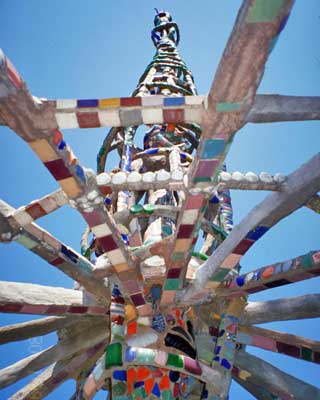
One of four children, Rodia was born in 1879 into a poor peasant family in Ribottoli, Campania, a village with few resources. Rodia followed an older brother in 1894 to Philadelphia where he began his American odyssey. Over the next fifteen years he moved from northern California to the southwestern United States and back to California, where in 1917 he settled in Long Beach. In 1921 he relocated again when he bought a small house on 107th Street in the Watts section of Los Angeles, at the time a largely Mexican immigrant neighborhood.37 Impetuous and difficulty to get along with, he divorced his third and last wife shortly after moving to Watts. Alone but not isolated in his community, after work each day at a Santa Monica tile factory, Rodia worked for the next thirty-four years on his towers. Then one day in 1955, having finished the towers, he simply abandoned them. He gave the property to a neighbor and disappeared. For many years, his whereabouts was unknown. He was even presumed dead. But in the early 1960s he was discovered alive and well in Martinez, California. He had lived just long enough to be recognized and honored for his remarkable towers.38
--------------------------
Rodia’s Los Angeles is characterized by capacious space and the omnipresence of sunlight. Light played a significant role in Rodia’s selection of materials for his towers and other sculptures. He traveled daily through neighborhoods that often contained large open spaces between residential developments and commercial and industrial sites.39 The houses were single-story bungalows that lined quiet, sunny streets. Before World War I, the motion picture industry moved from the northeast to Hollywood mainly because of the reliability of sunlight in which to do location shooting.40 In Golden Wedding Pagano used the phrase “history of light” in reference to the reason the motion picture industry moved from the East to Los Angeles. For the nickels it cost to see a movie in the 1920s and 30s, Hollywood’s films worked a similar kind of magic for immigrant Italians. They could see all those who had already “made America.”
The mythology of success has deep roots in American culture. As one European observer said in the 1920s, “The idea of success is in the blood of the nation, for the nation itself is success — the most gigantic success history has ever recorded.”41 Likewise, the mythology of success is recorded in Italian American literature, from the eastern works of D’Angelo and Lapolla to the California novels of Dorothy Bryant, Steve Varni, John Fante, Jo Pagano, and Lawrence Madalena. In both their detail and their extraordinary height, Rodia’s towers express his dream of success in America, as well as his recollection of his past.