|
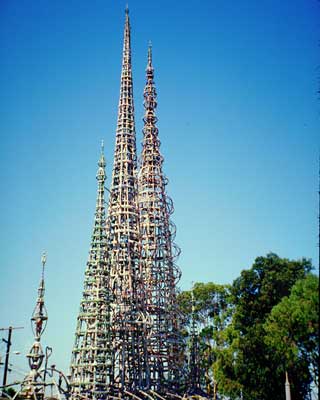
Light and the abundance of space were central to the form and content of the towers. In 1921 he purchased a house on a wedge-shaped lot with a spacious side yard, like most Southern California residential homes. The capacity to reflect light would be an important aspect of the materials he selected to festoon his seventeen different sculptures, including three towers standing between fifty-five and nearly one-hundred-feet tall. He collected fragments of glass, pop bottles, pottery, cups, plates, automobile glass, window glass, mirrors, bottoms of bottles, teapots and tiles, as well as seashells he gathered during is walks on Southern California beaches. The tiles, whole and fragments, came from a variety of manufacturers in Southern California. 42 He placed these in bins on the site and carefully selected the fragments for their placement. He kept a fire burning on the back of his property where he melted glass into free forms before he embedded them into the walls of his sculptures. 43 He used household and industrial objects to press designs into his drying mortar, from the backs of ice cream parlor chairs, wire rug beaters, and faucet handles, to gears, iron gates, grills, baskets, and cooking utensils. He poured mortar into cast-iron corn bread bakers, removed the dried mortar, and inserted the panels into his sculptures. On other surfaces he inscribed freehand designs into his wet mortar. 44 Into sections of his exterior wall, he pressed images of his tools — hammers, pliers, and files — signs of his immigrant working class values.
But Rodia’s site is not just a random collection of junk. It is a controlled work created from the many carefully selected materials collected from his surroundings.45 As the Southern California light passes over the multicolored surfaces of his sculptures during the day, it creates a polyphonic luminosity. The combination of freeform glass and tile fragments reflect the Southern California light in harmonic tones and shades. The elongated, arched buttresses that crisscross the site and that also form the round circles on the towers cast a network of changing shadows across the site. Like Southern California around it and like Rodia’s own life, the sculptures are not static. They change with the movement and intensity of the sun. Though made of reinforced concrete, the giant towers appear light and airy, more celestial than earth bound.
Just as important, many of the soft drink bottles are placed with their labels showing. The colorful fragments of the cups, saucers, tiles, plates, vases, and utensils are a cross section of the consumer life of the twenties and thirties.46 The objects that Rodia pressed into his sculptures have their identifiable sources in the community and industries that surrounded him in Southern California. Nevertheless, his sculptures transcend the period in which they were constructed and leave an indelible record of an immigrant mind that went beyond the parochial and the mundane. R. Buckminster Fuller credited Rodia with making innovations in his structural engineering. But Fuller was quick to add that Rodia’s innovations were “intuitive” and not just technical.47 The towers are a masterpiece of “grassroots art” that have permanently captured a record of both the era and the immigrant experience.
While the Towers are the creation of one man, they also express the recollections and hopes of generations of Italian immigrants in the New World. They are the paean of an Italian immigrant to both his past and his life in Southern California. Like Forestiere’s Underground Gardens, they express the psychological dislocating experience of immigration. But unlike Forestiere’s grottoes, Rodia’s towers provide a resolution to the problematic nature of the bicultural experience. Rodia collected the discards of modern America and organized them into a new form. At the same time, his construction, while it represents the present in its accumulation of contemporary artifacts, it also recalls the past.