|
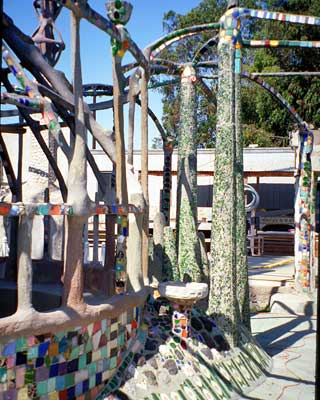
Folklorists I. Sheldon Posen and Daniel Ward have suggested that Rodia’s towers were based on the ceremonial gigli (lilies) annually paraded around the town of Nola, not far from his native village, in honor of the local patron saint, St. Paulinus.48 Each year around June 22, on the occasion of the feast honoring St. Paulinus, ceremonial gigli, towers that stood more than six stories high, and a ship are paraded around the streets of the town. The ceremony is referred to as the “Dance of the Gigli.” The bearers of the gigli towers “dance” through the streets to the accompaniment of a lively brass band. Since at least the sixteenth century, the “Dance of the Gigli” feast was organized by Nola’s eight craft guilds. The gigli represent the guilds and the ship symbolizes the return of St. Paulinus after his and other villagers’ kidnapping, liberation, and return from captivity during the fifth century. The shape of Rodia’s towers, especially the central tower, and the ship are nearly identical copies of the ones carried through the streets of Nola. Rodia named his ship the Marco Polo after the great explorer who opened Western culture to a world beyond its borders.
If we look at the immigrant literature of the period, what motivated him becomes as transparent as the iconography of his work. It is remarkable that one man built the towers without help from others or assistance from machinery. The Italian immigrants who flooded America at the turn of the century were little more than, in D’Angelo’s words, “pick and shovel” laborers.49 Even so, in spite of their hardships in the New World, like Pagano’s immigrants in Golden Wedding, they set out on another kind of voyage. As Lapolla explains in The Grand Gennaro, once settled, immigrants worked with a vengeance to overcome their historical subaltern status in Italy and in America. Lapolla’s main character, the Grand Gennaro, pounds his chest and boasts, “I, I made America, and made it quick.” Lapolla writes, “if one said of himself that he had made America, he said it with an air of rough boasting, implying ‘I told you so’ or ‘Look at me.’”50 It is often reported that Rodia wanted people to know how hard he had labored. He never failed to point out that he built his towers alone. Rodia was quoted as saying, “I’m gonna do something…. This is a great country.”51 Once someone showed Rodia a picture of Antonio Gaudi’s Church of the Sagrada Familia in Barcelona. Rodia asked, “Did he have helpers?” When he was told a crew of workers had built it, unimpressed, Rodia said, “I did it myself.”52
Rodia’s creation contrasts in important ways with Forestiere’s in Fresno. Though he owned considerable land in the San Joaquin Valley, Forestiere confined himself to a restricted space for his chambers. Though his one hundred grottoes underlie acres of land, spaciousness is not each individual room’s major characteristic. The visitor must duck at times to pass through a tunnel, and the majority of the rooms are little more than fifty to one hundred square feet. Forestiere remained isolated underground as he focused on those recollections of his village life in Filari. His signature was the black smudges that his lantern left on the arches of his tunnels. While Forestiere’s grottoes are characterized by a combination of seasonal light and darkness, by contrast, Rodia’s Towers are bathed daily in total sunlight, which is nearly constant in Southern California. Rodia inscribed his work with a public sign, Nuestro Pueblo, an appropriate name considering the Towers’ public location in the middle of his suburban, ethnic neighborhood.
Forestiere’s and Rodia’s creations contrast in their light/dark and public/private dimensions. However, what brings their two works together is that they also represent “home” for the two immigrant wayfarers.53 Forestiere’s Underground Gardens narrates for us the interior, private aspect of separation that characterizes all immigrant experiences in America. There is something fundamentally sad about a man who spent the better part of his life underground, recalling a past he could only revisit in his its derivative forms. But there is also something joyful in the gardens he planted and in his successful efforts to bring the sunlight, if only seasonally, into his underground grottoes and planters.
Both men narrated in their respective “dialects,” their inner turmoil inspired by the bicultural experience of Italian immigration. Rodia was surrounded by suburban and industrial America; Forestiere was surrounded by a rural landscape. Rodia merged the common images from his regional ceremonial spires with the found objects of modern industrial America. With his hand tools, the pick, shovel, and wheelbarrow, Forestiere used his hardpan “bricks,’ the most abundant resource he had, to create the arches and gardens of his Sicilian memories. Both men engaged in, what can only be termed, without fear of hyperbole, a Herculean labor. Work was a primary value that immigrant Italians brought with them as peasants to the New World. Rodia’s Watts Towers, in their unique decoration with the materials he found around him in Los Angeles, and their soaring heights, speak more eloquently to that dream of success that most immigrants brought to the New World than do Forestiere’s retrospective underground arches. Ultimately, both Simon Rodia and Baldassare Forestiere transcended their parochial, subaltern origins in Italy and inscribed a timeless message about the immigrant experience in their unique works.